
Sorter
What Sorter is
An open-source LEGO sorting machine: what it sorts, what it will not, and where to start if you want to build one.
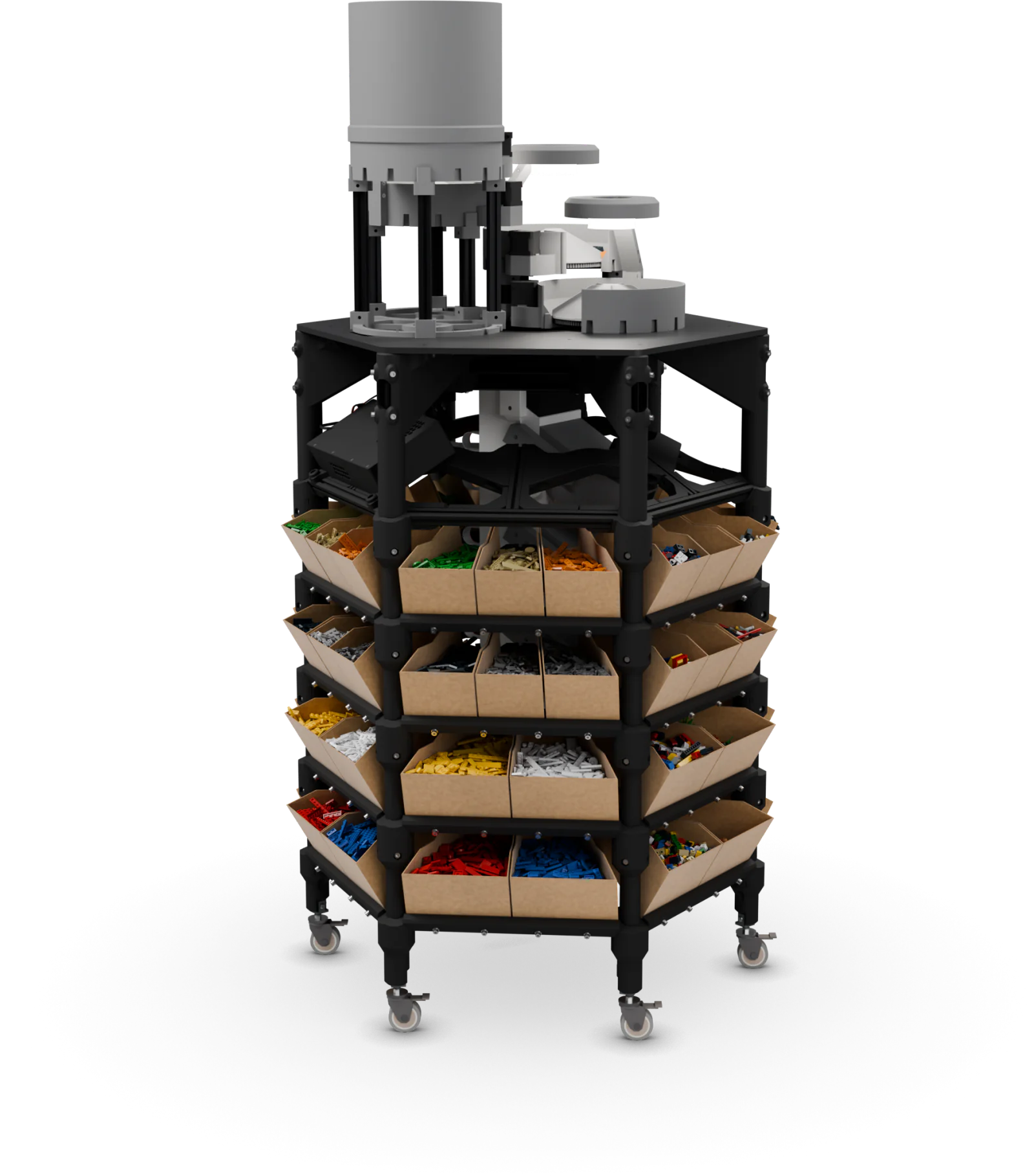
You feed bulk LEGO into a hopper. The machine separates the pieces one at a time, works out what each one is by part number (and by color, if you want), and drops it into the right bin.
Machines are built and running, and they sort every day. It is not a product yet: there is no kit and no price yet. What exists is the design, the parts list, and these instructions. For the latest, see the Basically website.
What it sorts: loose, rigid LEGO pieces up to ten studs in any direction. That is most of a mixed tub, not all of it, and the rest you pick out by hand before a run:
- Anything over ten studs. Baseplates, long plates and beams, boat hulls, large wheels and tank tracks.
- Tyres and anything rubber. Rubber grips where plastic slides, so a tyre stalls in a channel instead of dropping out of it.
- Cloth, string and chain. These tangle, with each other and with ordinary parts.
- Minifigures and their small accessories.
- Duplo, Primo and other brands.
Preparing LEGO is the full list, with what each thing does to the machine if it stays in.
How much it sorts at once is your choice. The machine is a stack of layers, each holding 18 bins or 12 larger ones, so more layers means more categories in one pass and more to build. Getting started has what a machine costs and what you need to build one.
Start here
Want to build a machine? Read this first: what it costs, the skills and tools you need, and the order to read the rest in. It also covers working on the project.
Start hereThe detail behind the build: machine sizes, parts counts and printing time, everything to buy and print, and the step-by-step assembly.
The software on the machine. Install it, set it up, calibrate the cameras and the chute, and run a sort.
The community space in the cloud: sorting profiles shared by other builders, the samples behind them, and the community review that checks those samples.
Research and contributor references: detector runtime findings, model artifacts, and benchmarks.